
Auto Insurance Discounts
Auto insurance discounts can lower your premium, but the important question is whether the savings are actually applied to the final quote. A discount may depend on your state, carrier, driving record, vehicle, mileage, billing method, student status, policy history, and whether you bundle more than one policy.
Use this guide to understand the most common discount types, how to verify them, and how to compare quotes without counting savings that are only possible. For a fair comparison, use the same ZIP code, drivers, vehicle details, coverage limits, deductibles, and payment setup before reviewing discounts.
Compare Auto Insurance Discounts by ZIP Code
Discount availability can vary by state and provider. Some savings are applied automatically, while others require proof, enrollment, or a policy review. Start with a quote baseline first, then confirm which discounts are already included and which still need approval.
Find Discount Options for Your Auto Quote
Request auto insurance quote options by ZIP code. Final pricing, coverage, discounts, and availability depend on the provider, state, vehicle, driver profile, and information submitted.
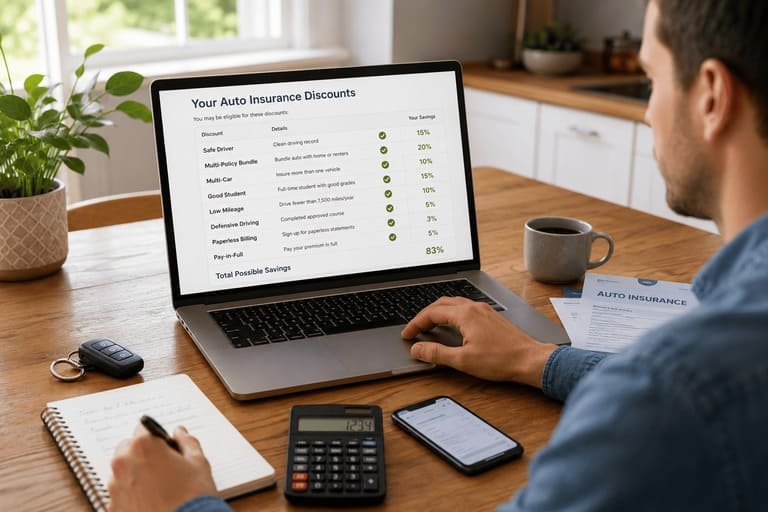
Main Auto Insurance Discounts to Check
Most insurers offer several discount categories, but the exact names, rules, and eligibility requirements can differ from one company to another. Do not assume a discount is included just because it appears on a marketing page or in a general list of possible savings. Some discounts are applied automatically, while others may require proof, enrollment, a clean driving record, a qualifying vehicle, a specific billing method, or final underwriting approval. Before choosing a policy, ask whether each discount is already applied to your quote, whether it can be combined with other savings, and whether it may change at renewal.
| Discount Type | What It Usually Means | What to Verify |
|---|---|---|
| Safe driver | Savings for drivers with limited accidents, claims, or violations | How many clean years are required and whether minor violations count |
| Multi-policy | Discount for bundling auto with home, renters, condo, or another policy | Whether the bundle is cheaper than separate policies with equal coverage |
| Telematics or usage-based | Pricing based partly on driving behavior, mileage, or app/device data | How driving is measured and whether the premium can change later |
| Multi-car | Discount for insuring more than one vehicle on the same policy | Which vehicles and drivers must be listed to qualify |
| Good student | Savings for qualifying full-time students with approved grades | Required GPA, age limits, school status, and proof deadlines |
| Defensive driving | Discount after completing an approved driver safety course | Whether the course is approved in your state and how long the discount lasts |
| Billing and payment | Savings for paperless billing, autopay, or paid-in-full plans | Whether fees offset part of the discount |
Applied vs Eligible Discounts
One of the biggest mistakes shoppers make is confusing eligible discounts with applied discounts. A discount can be available in theory but not included in the final premium yet. It may require proof of student status, course completion, vehicle equipment, prior coverage, mileage, or enrollment in a driving program.
Before choosing a policy, separate discounts into three groups: already applied, possible but not confirmed, and renewal-sensitive. This makes the quote easier to trust and helps you avoid comparing one confirmed premium against another quote that only shows potential savings.
| Discount Status | What It Means | What to Ask |
|---|---|---|
| Already applied | The discount is included in the displayed premium | Where can I see this discount in the quote or policy summary? |
| Eligible but not confirmed | You may qualify, but approval or documentation may still be needed | What proof is required, and when will the final premium update? |
| Program-based | Savings depend on app/device participation, mileage, or driving behavior | Can the program increase or decrease my premium later? |
| Renewal-sensitive | The discount may change after a claim, ticket, lapse, move, or mileage update | Which events can remove or reduce this discount? |
How to Maximize Discounts Without Weakening Coverage
The best discount strategy is not simply collecting the longest list of savings. A quote with a lower premium can still be a poor value if liability limits are reduced, the deductible is too high, or useful coverage is removed. First compare equal coverage, then review discounts.
Check the total policy cost
Compare the full policy term, not only the first payment. Review down payment, monthly installments, billing fees, renewal terms, and cancellation rules. A quote can look cheaper at the start but cost more over the full term.
Use bundling carefully
Bundling auto and home can help, but it should be tested against separate policies. Compare the combined annual cost, deductibles, coverage limits, and claim support before assuming a bundle is automatically the best option.
Review telematics before enrolling
Telematics programs may reward safer or lower-mileage driving where available. Before enrolling, ask how the program measures driving, how long the review period lasts, and whether the final premium can change after driving data is collected.
Brand Discount Comparison
Major auto insurers often promote similar discount categories, but eligibility rules and final savings can differ. Use this table as a checklist, not as a guarantee. Confirm details directly in your quote summary or with the provider before choosing a policy.
| Provider Type | Discounts Often Reviewed | What to Confirm |
|---|---|---|
| Large national carriers | Safe driver, multi-policy, telematics, multi-car, good student | Whether discounts are already included or still require enrollment |
| Agent-based providers | Bundle, loyalty, renewal, defensive driving, payment plan savings | Whether agent-applied discounts match the written quote summary |
| Usage-based programs | Mileage, braking, acceleration, phone use, driving time, safe driving score | Whether the program can change pricing after the review period |
| Budget-focused providers | Prior coverage, multi-car, payment method, renewal, basic safe driver | Whether lower price comes with reduced coverage or higher fees |
For more context, compare related pages such as our auto insurance comparison guide, save on car insurance guide, and auto insurance guide.
Auto Insurance Discounts: FAQ
These answers explain how to review discounts, verify savings, and avoid choosing a policy based only on possible discounts.
What are common auto insurance discounts?
Common auto insurance discounts may include safe driver, multi-policy, multi-car, good student, defensive driving, low mileage, paperless billing, paid-in-full, anti-theft, and telematics discounts. Availability depends on the provider and state.
Are all listed discounts already included in my quote?
No. Some discounts may be listed as possible savings but not yet applied. Ask whether each discount is already included in the premium or still requires proof, enrollment, or final underwriting approval.
Can I combine several auto insurance discounts?
Many insurers allow several discounts to be combined, but stacking rules vary. Compare the final premium after discounts are applied instead of assuming every possible discount will count.
How often should I review my auto insurance discounts?
Review your discounts at renewal and after major changes such as moving, adding a driver, buying a vehicle, completing a defensive driving course, changing mileage, or enrolling in a telematics program.
For additional consumer guidance, review the NAIC tips for saving on auto insurance, which discuss comparison shopping, giving complete information, asking about discounts, and reviewing policy details before switching.